For more intellectual property updates follow our WHATSAPP CHANNEL and SUNS LEGAL | LinkedIn
Introduction
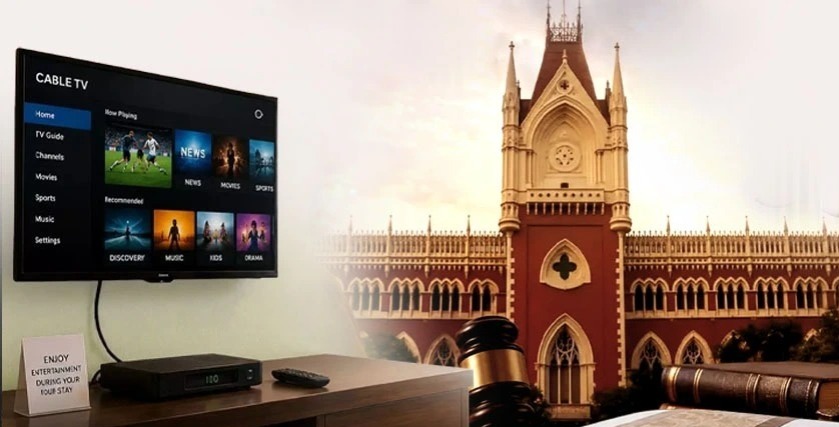
The Supreme Court has stayed a Calcutta High Court ruling that required hotels supplying cable television to guest rooms to obtain a separate copyright licence, reopening a question that had appeared settled only weeks earlier. In The Indian Performing Right Society Limited v. Hotel Appolo & Tours Private Limited (FMA 322 of 2025), the Calcutta High Court held on 4 August 2026 that a hotel providing cable connections to individual rooms goes beyond the role of an ordinary cable subscriber and “communicates” copyrighted works to the public under the Copyright Act, 1957, reversing a Trial Court order that had refused an injunction. Within weeks, Hotel Appolo approached the Supreme Court in Special Leave Petition SLP(C) No. 28489/2026, and on 20 August 2026 a Bench of Justices K.V. Viswanathan and Arun Palli granted an interim stay of the High Court’s order, issuing notice returnable 12 October 2026. The underlying question-whether a hotel supplying cable to individual guest rooms needs its own licence from a copyright society, or can rely on the licence its cable operator already holds – is, for now, back in play.
Facts of the Case
The Indian Performing Right Society Limited (“IPRS”), a copyright society holding its members’ rights of communication to the public, public performance, and mechanical rights under an Assignment Deed, found that Hotel Appolo & Tours Private Limited, which runs “Appolo Hotel,” had installed television sets connected to cable in every guest room, letting guests view programming carrying IPRS members’ works. IPRS wrote seeking a licence and royalty; the hotel refused, and no licence was ever obtained.
On 18 May 2023, IPRS filed OC Suit No. 9 of 2023 (CIS No. 01 of 2023) before the District Court, Darjeeling, seeking a permanent injunction, rendition of accounts, and damages of Rs. 9,00,000, along with an application under Order XXXIX Rules 1 and 2 read with Section 151 of the Civil Procedure Code for a temporary injunction. The hotel resisted, arguing it was merely a cable subscriber and that the licensing obligation lay with the cable operator under the Cable Television Networks (Regulation) Act, 1995.
By Order No. 18 dated 20 September 2024, the District Judge, Darjeeling, dismissed the injunction application, holding that the “Broadcasting Right” under Section 37 is distinct from copyright and that IPRS had no right to challenge it in the suit, that the hotel had denied involvement so no prima facie case was made out, and that other principles governing temporary injunctions also did not favour IPRS and the decision was appealed by IPRS.
On 4 August 2026, a Division Bench allowed the appeal, set aside the Trial Court’s order, and granted the injunction IPRS had sought. Hotel Appolo then moved the Supreme Court, filing SLP(C) No. 28489/2026 along with an application for exemption from filing a certified copy of the judgment, which the Court allowed on 20 August 2026.
Argument in Favour
Before the High Court, the hotel argued that it had merely subscribed to cable connections from an operator who already held broadcast reproduction rights and had presumably paid royalty, so it could not be made to pay again; that private viewing in guest rooms was not “communication to the public”; and that under the Cable Television Networks (Regulation) Act, 1995, the licensing obligation rests on the cable operator, who had not even been impleaded in the suit.
Before the Supreme Court, Senior Advocate Neeraj Kishan Kaul, appearing for the hotel, argued that the petitioner was not transmitting signals to any other person but was merely their recipient, relying on paragraphs 28 and 40 of Hotel & Restaurant Association & Another v. Star India (P) Ltd. & Others, (2006) 13 SCC 753. He submitted that Section 52(1)(k)’s reference to an “enclosed room meant for common use” could not be stretched to cover individual hotel rooms, and distinguished Supercassette Industries Ltd. v. Nirula Corner House (P) Ltd., 2008 SCC OnLine Del 360 – the decision the High Court had relied on – on the ground that it arose from an application under Order VII Rule 11 of the Civil Procedure Code and never considered Star India. He further submitted that the Trial Court had rightly declined injunction, that IPRS had never held an interim order in its favour during the appeal, and that compelling the hotel to now seek a licence would be contrary to law.
Argument Against
IPRS’s case, as recorded in the High Court judgment, was that a licence from it is mandatory under the Copyright Act, 1957 for commercial exploitation of its members’ works, and that Section 2(ff), defining “communication to the public,” covers cable connections provided in hotel rooms – relying on Supercassette Industries v. Nirula Corner House. IPRS argued the Trial Court had wrongly equated the cable subscription fee with the licence fee payable to it, since copyright under Section 14 and the broadcast reproduction right under Section 37 are distinct, with Section 39A preventing the latter from overriding the former; the hotel, not being a broadcasting organisation, could not claim Section 37’s benefit. For this, IPRS relied on Vodafone Idea Limited v. Indian Performing Right Society Limited, 2026 SCC OnLine Cal 5736, holding that copyright in an underlying work survives independently even within a sound recording or film. IPRS has not yet appeared before the Supreme Court; the Bench has issued notice, returnable 12 October 2026.
Court’s Decision
The Calcutta High Court held that Section 2(ff)’s Explanation deems communication through cable or satellite to more than one household or hotel or hostel room to be communication to the public, and that cable connections supplied to multiple hotel rooms fell within this. It held the hotel did not qualify as a “subscriber” under Section 2(i) of the Cable Television Networks (Regulation) Act, 1995 – which protects only a person who receives a signal “without further transmitting it to any other person” – since it supplied the signal onward to its guests. It relied on Vodafone Idea Limited’s reasoning that royalties on an underlying literary or musical work survive independently within a sound recording or film, except when exhibited in a cinema hall. On infringement, it applied Section 52(1)(k), which excludes hotels and similar commercial establishments from the exception for enclosed common-use rooms in residential premises, following Supercassette’s holding that this exclusion should be read strictly given Parliament’s deliberate wording; it also weighed the “question of proportions” from Hubbard v. Vosper, 1972 (1) All ER 1072, noting that a television in every guest room differs from one set in a common area. The Bench found the hotel guilty of infringement under Section 51, held IPRS had made a strong prima facie case with the balance of convenience in its favour, set aside the Trial Court’s order, and allowed the appeal without costs.
Weeks later, the Supreme Court took a different interim view. Hearing only Senior Advocate Kaul for the hotel – IPRS was not represented – the Bench of Justices Viswanathan and Palli, after considering the arguments summarised above, issued notice returnable 12 October 2026 and ordered “an interim stay of operation of the impugned order” until the next hearing.
Conclusion
The Supreme Court’s order is an interim stay at the notice stage, not a ruling on the merits – the underlying question of whether a hotel’s cable subscription shields it from a copyright society’s separate licensing demand remains open, and will next be heard on 12 October 2026. For now, the stay restores the position that existed before the High Court’s judgment: hotels are not, on the strength of this case, required to obtain a separate IPRS licence for cable television in guest rooms.
The dispute captures a genuine tension in Indian copyright law – between the deeming provision in Section 2(ff)’s Explanation, which treats cable transmission to multiple hotel rooms as communication to the public, and the argument that a hotel supplying an already-licensed cable signal is merely a recipient, not a rebroadcaster. How the Supreme Court resolves that tension will matter well beyond this one hotel: it goes to how hotels, resorts, and similar establishments across India structure their arrangements with cable operators and copyright societies. Until then, this remains a live, unsettled question, and nothing in the High Court’s reasoning – however detailed – currently governs the outcome.