For more intellectual property updates follow our WHATSAPP CHANNEL and SUNS LEGAL | LinkedIn
Introduction
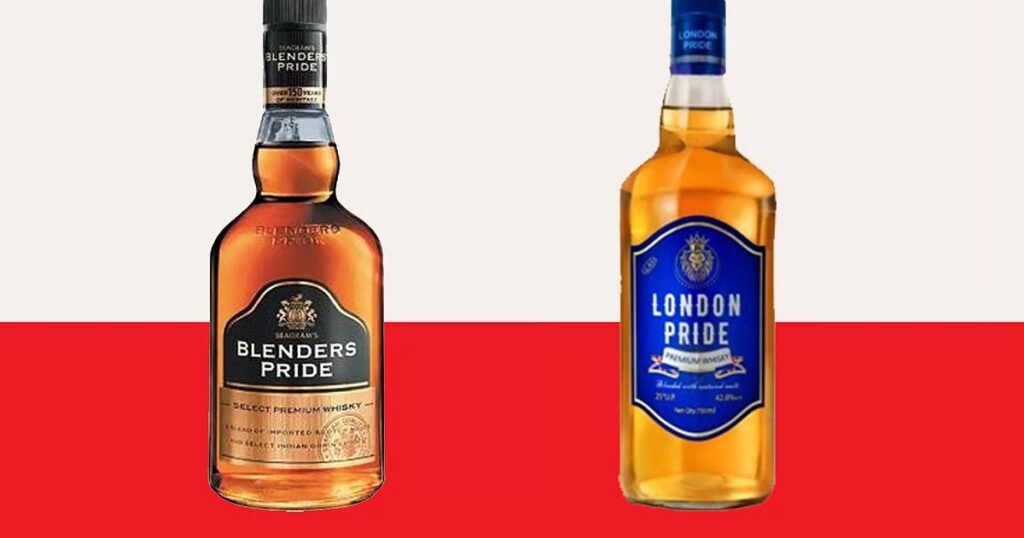
This case discusses whether the maker of the well-known whiskies Blenders Pride and Imperial Blue could prevent a rival from selling whisky under the brand name London Pride. Pernod Ricard India Pvt. Ltd., which markets these established brands, alleged that the rival’s mark and packaging were deceptively similar to its own and that the bottles even carried the embossing “SEAGRAM’S,” which is a registered house mark belonging to Pernod. The company sought an interim injunction to restrain the rival from using the disputed mark and packaging. Both the Commercial Court and the High Court refused to grant the injunction, and the Supreme Court upheld their decisions. In doing so, the Court revisited settled principles of trademark law: that marks must be compared as a whole, that common or laudatory words like “Pride” cannot be monopolised without proof of distinctiveness, and that the overall impression on the average consumer is what determines confusion.
Facts of the Case
Arguments in Favour (Appellants – Pernod Ricard)
Pernod Ricard argued that the mark London Pride was deceptively similar to its own Blenders Pride. Both marks, it claimed, shared the essential feature “Pride,” and since the goods were identical, Indian-made foreign liquor (IMFL whisky) and sold through the same channels, there was a high likelihood of confusion or association among consumers. Under Sections 28 and 29 of the Trade Marks Act, 1999, the registered proprietor enjoys exclusive rights to the mark, and infringement depends on the likelihood of confusion, not proof of actual deception.
The company also alleged that the trade dress and label of London Pride were designed to imitate Imperial Blue, particularly the colour scheme of blue and gold, the get-up, and the layout. These, Pernod pointed out, were distinctive device marks it had registered, and their imitation amounted to infringement even if the words differed.
Another important grievance was the use of bottles embossed with Seagram’s, a registered house mark. According to Pernod, the continued use of these bottles by the rival amounted to direct trademark infringement, a matter that the appellate courts had failed to consider adequately.
In terms of precedent, Pernod argued that the lower courts had wrongly relied on S.M. Dyechem Ltd. v. Cadbury (India) Ltd., (2000) 5 SCC 573 instead of following the landmark judgment in Cadila Health Care Ltd. v. Cadila Pharmaceuticals Ltd., (2001) 5 SCC 73, which stressed that marks must be compared in their entirety and that the test is the perception of the average consumer with imperfect recollection. The company cited Amritdhara Pharmacy v. Satya Deo Gupta, AIR 1963 SC 449 and Durga Dutt Sharma v. Navaratna Pharmaceutical Laboratories, AIR 1965 SC 980 to argue against dissecting marks into parts. For dishonest adoption and the need for strong interim protection, they relied on Midas Hygiene Industries (P) Ltd. v. Sudhir Bhatia, (2004) 3 SCC 90, Heinz Italia v. Dabur India Ltd., (2007) 6 SCC 1, and T.V. Venugopal v. Ushodaya Enterprises Ltd., (2011) 4 SCC 85. They even invoked the concept of initial interest confusion, citing Baker Hughes Ltd. v. Hiroo Khushlani, (2004) 12 SCC 628, to argue that consumers might initially be drawn to the rival product under a mistaken belief, which itself constitutes unfair competition.
On the issue of interim relief, Pernod submitted that it had established a strong prima facie case, that the continued use of the rival mark would cause irreparable harm through dilution of its brand, and that the balance of convenience lay firmly in its favour.
Arguments Against (Respondent – Karanveer Singh Chhabra)
The respondent argued that London Pride and its packaging were neither visually nor phonetically similar to Blenders Pride or Imperial Blue. The products were sold in sealed cartons with distinct labels, typefaces, and layouts, and there was little chance that an ordinary consumer would confuse one for the other when viewed as a whole.
It was further argued that the word “Pride” is a common and laudatory term, widely used in the liquor trade. Under Section 17(2) of the Trade Marks Act, a proprietor of a composite mark cannot claim exclusive rights over individual, non-distinctive components of that mark. According to the respondent, the dominant elements of the marks in question were “Blenders,” “Imperial,” and “London”, which were entirely different from each other.
The respondent also emphasized that interim injunctions are an extraordinary remedy and should not be granted unless the plaintiff demonstrates irreparable harm that cannot be compensated by damages. In the matter, Pernod had not established that such harm was likely to occur. Relying on principles from American Cyanamid Co. v. Ethicon Ltd., [1975] UKHL 1, it was submitted that at most, Pernod had raised a triable issue, but that was not sufficient to justify an injunction before trial.
Legal Provisions
The case involved key provisions of the Trade Marks Act, 1999. Section 2(h) defines “deceptively similar” as marks that so closely resemble each other that they are likely to cause confusion. Sections 2(m), 2(q), 2(v), 2(w), and 2(zb) provide definitions of “mark,” “package,” “registered proprietor,” “registered trademark,” and “trademark,” establishing the scope of protection.
Section 9(1) sets out absolute grounds for refusal, including marks that are descriptive or lack distinctiveness unless they have acquired secondary meaning. Section 11 bars registration of marks similar to earlier ones where confusion is likely. Section 15 allows for registration of a series of marks.
Most importantly, Section 17 makes it clear that rights are granted in respect of the mark as a whole, and proprietors cannot monopolise individual, common components of composite marks. Section 27(2) preserves the action of passing off even for unregistered marks. Section 28 grants exclusive rights to registered proprietors, while Section 29 defines infringement, including use of identical or similar marks for identical or similar goods where confusion is likely. Section 135 provides remedies, including injunctions, damages, and accounts of profits.
The request for interim relief was made under Order XXXIX Rules 1–2 CPC, which allow courts to grant temporary injunctions to preserve rights and prevent immediate harm.
Court’s Decision
The Supreme Court reiterated that marks must be compared as a whole and not dissected into individual parts. Pernod’s rights were over the composite mark Blenders Pride, not over the word Pride standing alone. Under Section 17, common or laudatory words cannot be monopolised unless it is shown that they have acquired distinctiveness through extensive use. Since Pernod did not demonstrate that “Pride” alone had acquired secondary meaning identifying its product, the Court held that exclusivity over the word could not be claimed.
The Court further noted that “Pride” is a laudatory word that has been widely used in the liquor industry. Relying on cases such as Godfrey Philips India Ltd. v. Girnar Food & Beverages (P) Ltd., (2005) 30 PTC 1 (SC), the Court emphasised that such descriptive or laudatory terms can only be protected if the proprietor establishes secondary meaning. Earlier rulings like Corn Products Refining Co. v. Shangrila Food Products Ltd., AIR 1960 SC 142 and National Bell Co. v. Metal Goods Manufacturing Co. (P) Ltd., (1970) 3 SCC 665 were also cited to underline that mere entries on the register do not prove distinctiveness.
On the issue of overall impression, the Court applied the classic Pianoist test looking at the marks in terms of their look, sound, and idea. It held that Blenders Pride and Imperial Blue on one hand and London Pride on the other conveyed different impressions. The addition of the word “London,” the different typography, and the overall layout meant that consumers would not likely be misled. The Court relied on Cadila Health Care Ltd. v. Cadila Pharmaceuticals Ltd., (2001) 5 SCC 73, Lloyd Schuhfabrik Meyer & Co. GmbH v. Klijsen Handel BV, Case C-342/97, [1999] ECR I-3819 (CJEU), and English cases like Parker-Knoll Ltd. v. Knoll International Ltd., [1962] RPC 265 (HL) and Aristoc Ltd. v. Rysta Ltd., (1945) 62 RPC 65 (HL) to reinforce the principle that marks must be judged from the perspective of the average consumer with imperfect recollection.
As for the similarity of labels and trade dress, the Court held that while both products used blue and gold, the overall get-up and layout were different. Without evidence that specific features like the colour or bottle design had become distinctive identifiers of Pernod’s products, no case of deliberate imitation was made out at the interim stage.
The allegation of using bottles embossed with Seagram’s was not ignored but was left to be decided at trial, as the interim materials were insufficient to warrant an immediate restraint.
Applying the principles for interim injunctions, including those laid down in American Cyanamid Co. v. Ethicon Ltd., [1975] UKHL 1, the Court found that although there was a serious issue to be tried, the likelihood of confusion was weak, the balance of convenience did not favour Pernod, and irreparable harm was not established. It distinguished earlier cases like Midas Hygiene Industries (P) Ltd. v. Sudhir Bhatia, (2004) 3 SCC 90, where dishonest adoption was clearly proved. The Court also noted that in prior litigation against United Spirits over the use of “Pride,” Pernod had also failed to secure interim relief, which showed the courts’ consistent reluctance to treat “Pride” as monopolizable within a composite mark.
Accordingly, the Supreme Court dismissed the appeal and upheld the lower courts’ refusal to grant an interim injunction. It directed the Commercial Court to expedite the trial without being influenced by its observations at the interim stage.
Conclusion
The Supreme Court’s refusal to grant interim relief in the London Pride case emphasizes several settled principles of trademark law in India. First, rights in a composite mark extend to the mark as a whole, not to individual common words within it. Second, laudatory or descriptive words like “Pride” cannot be monopolised unless they have acquired secondary meaning through use and consumer association. Third, the overall impression of the mark, label, and trade dress on the average consumer is what ultimately matters in deciding confusion. Finally, interim injunctions will not be granted unless a strong prima facie case of confusion is made out, coupled with proof of irreparable harm and a favourable balance of convenience.
For brand owners, this ruling indicates the need to gather and present evidence of acquired distinctiveness if they wish to protect common words. For defendants, the decision demonstrates that using common words in a distinctive overall setting may not always amount to infringement.
The Court’s decision does not finally determine the issue; the trial will proceed and evidence will be considered in detail. But at this stage, it clearly shows that trademark law is aimed not at conferring monopolies over ordinary language, but at protecting distinctive, source-identifying features that genuinely matter to consumers.