For more intellectual property updates follow our WHATSAPP CHANNEL and SUNS LEGAL | LinkedIn
Introduction
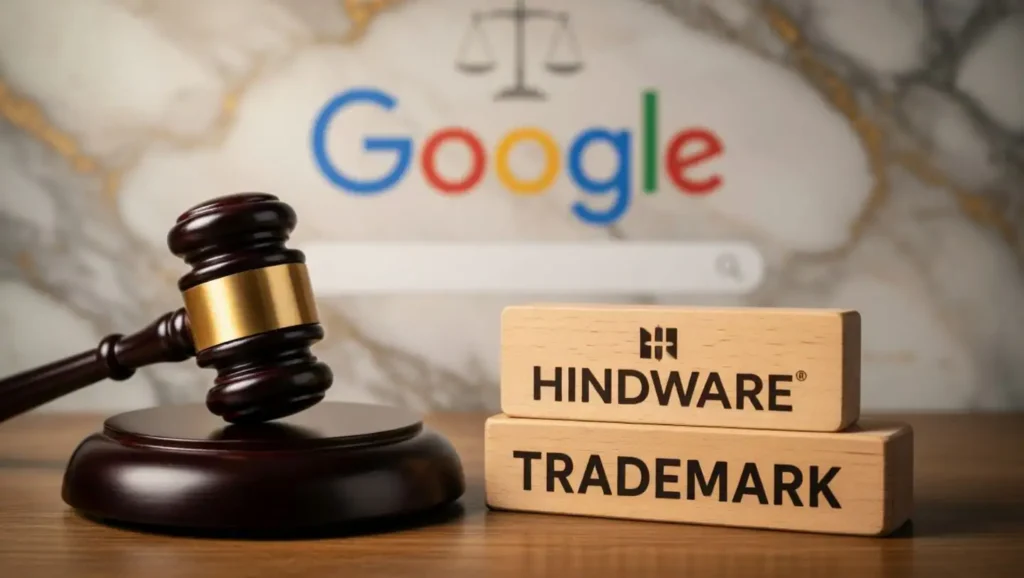
On 22 May 2026, the Delhi High Court in Hindware Limited v. Google India Pvt. Ltd. & Google LLC, CS(COMM) 591/2017 & CS(COMM) 592/2017, addressed a significant question in trademark law concerning the use of registered marks as keywords in online advertising. The dispute arose when Hindware discovered that its well-known trademark “HINDWARE” was being purchased and used by competitors in Google’s AdWords Programme, thereby diverting internet traffic away from Hindware’s official website. The Court was called upon to determine whether such keyword bidding amounted to infringement, passing off, unfair competition, and dilution under the Trade Marks Act, 1999, and whether Google could claim immunity as an intermediary under the Information Technology Act, 2000.
Facts of the Case
Hindware Limited, a leading sanitaryware company established in 1960, enjoys nearly 40% market share in the organized sector and has consistently invested in building its brand reputation. Its trademark “HINDWARE” was declared a well-known mark by the Delhi High Court in HSIL Ltd. v. Kripton Ceramics Pvt. Ltd. (2017).
In 2013, Hindware discovered that Cera Sanitaryware, through its developer Omkara Infoweb, had purchased “HINDWARE” as a keyword in Google’s AdWords Programme. This meant that when users searched for “HINDWARE,” Cera’s website appeared as the top sponsored link. In 2014, Hindware found that Grohe India had similarly purchased “HINDWARE” as a keyword, diverting traffic to its own website.
While Grohe, Cera, and Omkara Infoweb eventually settled with Hindware, the suits continued against Google India and Google LLC, focusing on Google’s liability in facilitating such infringement. Hindware demonstrated its strong market standing with sales exceeding ₹534.87 crores in 2011–12 and advertising expenditure of ₹55.98 crores in the same year, underscoring the goodwill attached to its mark.
Argument in Favour
The plaintiff argued that “HINDWARE” was a coined word with no dictionary meaning and enjoyed significant reputation and goodwill. Hindware contended that using a trademark as a keyword to trigger advertisements constituted “use in advertising” under Section 29(6)(d) of the Trade Marks Act, 1999. Hindware contended that Google was not a passive intermediary but actively suggested, auctioned, and sold trademarks as keywords to competitors for commercial gain. This conduct amounted to taking unfair advantage of Hindware’s reputation and was contrary to honest commercial practices, thereby bringing the conduct within the ambit of Section 29(8).
The plaintiff further argued that Google should not be entitled to safe harbour protection under Section 79 of the IT Act, 2000, because it was actively involved in monetizing the use of the infringing marks through its Keyword Planner Tool and auction system. By allowing competitors to bid on Hindware’s mark, Google facilitated unfair competition and dilution of the trademark’s distinctiveness.
Argument Against
The defendants challenged the suits on multiple grounds. They argued that the Delhi High Court lacked territorial jurisdiction since Hindware’s registered office was in Kolkata. They also contended that keywords were backend triggers, imperceptible to users, and therefore did not constitute “use” of a trademark in the legal sense.
Google maintained that it merely provided a platform for third-party data and should be protected as an intermediary under Section 79 of the IT Act, 2000. It further argued that the use of keywords promoted fair competition by offering consumers alternative choices. Additionally, Google claimed that Hindware was estopped from alleging infringement because it had previously bid on competitors’ trademarks such as “CERA” for its own advertisements.
Court’s Decision
The Delhi High Court ruled in favour of Hindware, holding Google liable for trademark infringement.
On the issue of jurisdiction, the Court affirmed its jurisdiction, noting that Google’s services were accessible in Delhi and the advertisements were visible to users within its territorial limits. The Court relied on Burger King Corporation v. Techchand Shewakramani, 2018 SCC OnLine Del 10881, to support its reasoning.
On the question of “use in advertising,” the Court held that keyword bidding was a commercial activity that fell squarely under Section 29(6) of the Trade Marks Act, 1999, as it formed an essential part of the advertising process.
The Court found Google liable under Section 29(8) for taking unfair advantage of Hindware’s reputation. It observed that auctioning a coined mark to rivals was dishonest and impaired the trademark’s advertising function. In reaching this conclusion, the Court referenced Google LLC v. DRS Logistics (P) Ltd., 2023 SCC OnLine Del 4809, which had similarly dealt with keyword advertising and trademark infringement.
The Court denied Google safe harbour protection under Section 79 of the IT Act, 2000, because its Keyword Planner Tool and auction system demonstrated active participation and monetization of the marks.
As relief, the Court granted a permanent injunction against Google LLC and Google India under Section 135 of the Trade Marks Act, 1999. Although proof of actual loss was insufficient, the Court awarded nominal damages of ₹30,00,000 (₹15 lakhs per suit) along with litigation costs. In doing so, it cited Koninklijke Philips N.V. v. Jain Electronics, 2024 SCC OnLine Del 5594, which had emphasized the importance of awarding costs and damages even in the absence of precise quantification of loss.
Conclusion
The Delhi High Court concluded that trademarks are valuable commercial assets protected as property under Article 300A of the Constitution of India. By auctioning the “HINDWARE” mark without consent, Google and its advertisers were found to have misappropriated the mark, diverting internet traffic from the legitimate proprietor.
This judgment is significant because it clarifies that while competition is encouraged, it cannot be achieved through dishonest misappropriation of another’s intellectual property. The Court’s reasoning strengthens the enforcement framework for trademarks in India, particularly in the digital advertising space. By holding Google accountable, the Court has sent a clear message that intermediaries cannot escape liability when they actively facilitate infringement.